
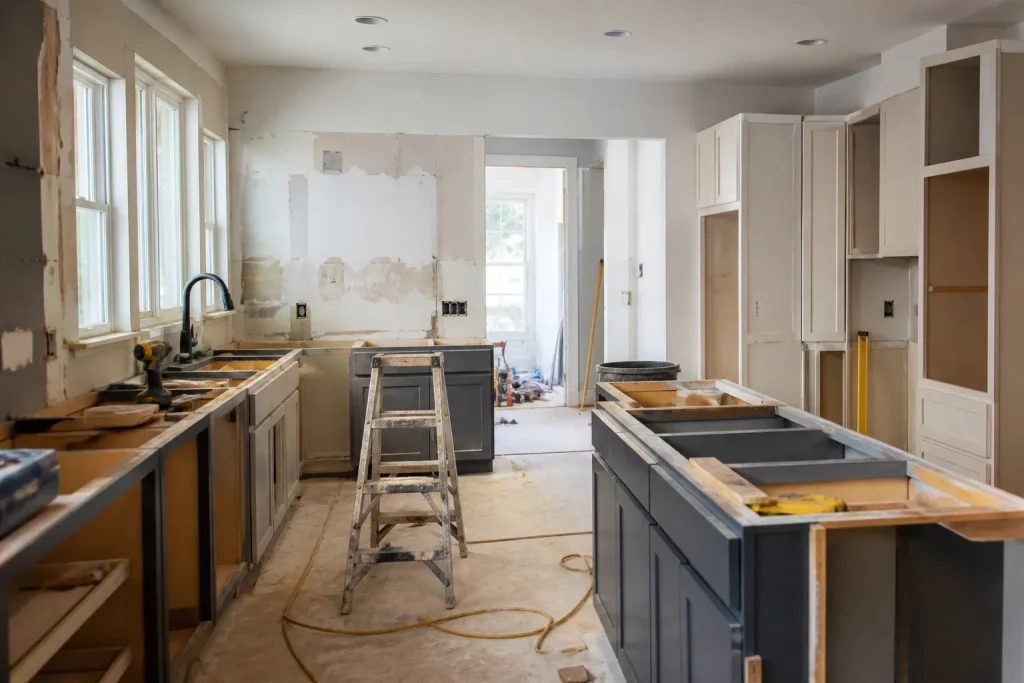

5 Mistakes to Avoid With Kitchen Remodeling
The five costliest kitchen remodeling mistakes in Spring Valley aren’t about cabinet color or countertop edges. They happen in the first 72 hours, before a single wall is opened: a verbal scope instead of a written line-item price, appliances ordered without a construction timeline, no real dust containment, cabinet lead times nobody verified, and no clear answer to what “done right” actually means six months later. Get those five decisions right and most budget overruns never happen. If you’d rather not gamble on it, call (844) 320-4882 and we’ll walk your kitchen with you.
Key Takeaways
- A written, line-item price before demolition is the single most protective document you can hold.
- Appliance delivery dates must be tied to the construction schedule, not the sales calendar.
- Painter’s plastic does not contain kitchen dust. Floor-grade drop cloths and ZIP System barriers do.
- Verify cabinet lead times in writing before you sign, not after the backorder email.
- “Done right” needs a defined remedy, not a handshake.
Mistake 1: Approving a Verbal Scope Instead of a Written, Line-Item Price

This is the mistake that causes most of the rest. When a contractor opens a wall in a Spring Valley home and finds something unexpected – old galvanized plumbing, a joist that’s been notched by a previous remodel, knob-and-tube wiring behind the drywall – the honest question is “how does this change the price?” The dishonest answer is a verbal one delivered in a gutted kitchen while you’re trying to make school lunches on a card table.
A written, line-item price before any work starts means every allowance, every fixture, and every labor line is on paper before demolition day. When something is discovered behind the wall, that discovery gets written into a change order with a number attached – before the crew touches it. No number, no work. That single rule prevents the majority of budget overruns we hear about from homeowners in Spring Valley who came to us after a rough first attempt.
- Ask for the price in writing, itemized, before demolition starts – not a lump sum, not a range.
- Every allowance (tile, countertop, cabinets) should be a fixed dollar figure, so you know what happens if you choose something above it.
- Change orders should be written documents with numbers, signed before the work proceeds.
- “We’ll figure it out as we go” is a business model, and you’re the one paying for it.
Every project we take on gets a written price before any work starts. It’s not a courtesy – it’s the document that keeps the last 20% of the job from quietly doubling.
Mistake 2: Not Sequencing Appliance Delivery Against the Construction Timeline
A refrigerator that arrives two weeks early sits in your garage in a Spring Valley summer heat wave. A refrigerator that arrives two weeks late leaves a cabinet opening, an electrical hookup, and a contractor waiting – and idle time gets billed, one way or another. Either the crew reschedules (and pushes your project back), or the finished kitchen sits without a working fridge for another week while everyone waits.
The fix is a written schedule that ties every major appliance delivery to a specific construction milestone. Countertop template happens after cabinets are set. Appliance hookups happen after countertops, plumbing rough-in, and electrical are complete and inspected. If you’re ordering a range hood, a built-in microwave, or a panel-ready refrigerator, the cabinetmaker needs the exact specs before the boxes are cut, not after.
The same discipline applies to fixtures. Faucets, sinks, and garbage disposals from brands like Kohler, Moen, Blanco, and Delta should be on site – in the room, unboxed, checked for damage – before the plumber arrives. A missing faucet on install day is a plumber coming back a week later, and a callback charge you probably didn’t budget for.
Mistake 3: Skipping a Real Dust and Debris Containment Plan

Kitchen dust is not sawdust from a single afternoon of carpentry. It’s drywall dust, thinset dust, cabinet filler dust, and demo debris from a wall that’s been standing since your house was built. In homes with kids and pets, that dust goes everywhere: the air handler pulls it through every room in the house, it settles on cribs and dog beds, and it coats every surface in the bedrooms upstairs.
Painter’s plastic taped over a doorway does very little. Real containment means floor-grade drop cloths – the heavy canvas or poly-backed kind, not the thin sheeting at the paint store – plus ZIP System barriers or zip-wall doorways between the work zone and the rest of the house. Add a HEPA-filtered air scrubber running through demo, and you can keep the air in the rest of the house close to normal. On a Spring Valley kitchen where the family is sleeping two rooms away, the difference between a properly contained job and a badly contained one is usually the difference between a family that stays home during the remodel and a family that moves into a hotel for six weeks.
We bring shoe covers and floor-grade drop cloths to every visit, and we take a photo of the clean-up before we leave. That’s part of what we call clean up like it is our own home, and it’s not optional on any project.
Mistake 4: Choosing Cabinet Brands Without Verifying Lead Times
The current supply environment is not the one from five years ago. Cabinet manufacturers are running lead times anywhere from eight to sixteen weeks on standard lines, and longer on semi-custom or custom. That means a kitchen that finishes cabinets on the last week of the project schedule is a kitchen that sits functionally unusable for another month.
Ask for the lead time in writing, from the manufacturer, with a ship date attached. Not a verbal “about ten weeks” from the dealer. If your kitchen has a KraftMaid or Wellborn cabinet plan, ask the dealer to confirm the current ship time against the model and finish you’ve chosen – some finishes run longer than others. Then sequence the project so your cabinet delivery window matches your box installation date, with a two-week buffer built in.
If the lead time is longer than the buffer allows, you have two choices: shift the project schedule to match, or pick a different cabinet line with a shorter ship time. Both are fine. Neither is fine if you find out at week ten that the manufacturer is running six weeks behind.
Mistake 5: Not Asking What the “Done Right” Recourse Is

A tile row that’s a quarter-inch off. A drawer that doesn’t close flush. A cabinet door that warps slightly after six months of Spring Valley summer humidity. Every one of these is fixable – the question is by whom, at whose cost, and how long after the project is “complete.”
Ask the question directly: “What happens if something isn’t right six months from now?” A contractor with a real answer says something like: “We come back, we fix it, at no charge.” A contractor with a weak answer says something like “We stand behind our work” and then changes the subject. Get the first answer in writing.
We give every completed project a 365-Day Done Right Promise: if it’s not done right after the job is complete, we make it right. That’s not a marketing line – it’s the standard we’re held to, and it’s part of why we ask parents in Spring Valley to look at a completed kitchen from eleven months ago, not just a showroom.
When to Call a Pro
If any of these apply, the kitchen math gets complicated fast, and it’s worth having a real conversation before demolition day:
- You’ve heard “we’ll figure it out as we go” from anyone.
- You don’t have a written price with line items in front of you.
- You’re not sure what happens if a cabinet backorder hits six weeks into the job.
- The person quoting you can’t tell you where the wall is or what’s behind it.
- The last contractor’s idea of containment was a tarp in the doorway.
Those are not reasons to give up on the project – they’re reasons to slow down the front end. Every one of them costs nothing extra to fix.
Related Services in Spring Valley
If you’re remodeling a kitchen, you may also be considering the space next to it. Our Bathroom Remodeling in Spring Valley team handles the same written-price, contained-work, done-right standard. And if your project grows beyond the kitchen, our General Contractor in Spring Valley service coordinates the full build. You can see the whole picture on our Elmstead Remodeling Spring Valley home page, or read more about our Kitchen Remodeling in Spring Valley work directly.
What happens when you call
- 1
A real person answersNo phone trees – you reach a local pro.
- 2
You get an upfront price rangeHonest numbers before anyone is dispatched.
- 3
A background-checked tech heads outLicensed & insured, dispatched right away.
- 4
You approve before work beginsNothing starts until you say go.
The Bottom Line
The five most expensive mistakes in a kitchen remodel all happen before demolition: a verbal scope instead of a written line-item price, appliances disconnected from the construction schedule, no real dust containment, cabinet lead times nobody verified, and no defined remedy for “done right.” Fix those five on the front end and the project budget stays honest, the family stays in the house, and nobody is making school lunches in a gutted room because a wall got opened without a number on paper.
If you’re in Spring Valley and you want to have that conversation with someone who will show you a written price before any work starts, Elmstead Remodeling Spring Valley offers free estimates. Call (844) 320-4882. Our technicians have up to 21 years of experience, and every completed project gets a 365-Day Done Right Promise – if it’s not done right, we make it right.
Frequently Asked Questions
Most full kitchen remodels in Spring Valley land in a broad range depending on cabinet line, countertop material, and whether walls move. A refresh – cabinets refaced or painted, new countertops, new fixtures – is a smaller number than a full gut-and-replace, which is a larger number again. What you can control is the process: get a written line-item price before demolition, hold every allowance as a fixed dollar figure, and require written change orders for anything found behind the wall. That’s the difference between a firm number and one that quietly grows. Call (844) 320-4882 for an exact written quote – estimates are free.
A typical Spring Valley kitchen remodel runs six to ten weeks from demo day to final walk-through, assuming cabinet lead times are verified before you order and appliances are scheduled against the construction timeline. The two biggest schedule surprises are usually cabinet backorders (which is why we ask for the manufacturer’s ship date in writing) and appliance delivery timing. If a wall gets opened and something unexpected shows up – old wiring, a plumbing surprise – that can add days, which is exactly why we get the change order in writing before the crew touches it.
Yes, and most Spring Valley families with kids and pets do. The two things that make it work are containment and quiet hours. Real containment means ZIP System barriers and floor-grade drop cloths – not painter’s plastic – plus a HEPA air scrubber running through demo. Quiet hours mean we schedule the loudest work (demo, tile cutting, cabinet install) during school and nap hours where possible, so the house is still livable at bedtime. We bring shoe covers and drop cloths on every visit, take a photo of the clean-up before we leave, and ask before we move anything in the house.
That depends entirely on what the contractor put in writing. We give every completed project a 365-Day Done Right Promise: if it’s not done right after the job is complete – a tile row that’s off, a drawer that doesn’t close flush – we come back and we make it right at no charge. That’s the answer you want in writing from anyone you hire, and it’s worth asking before demolition day. Call (844) 320-4882 if you want to talk through what that looks like on a Spring Valley kitchen.
Written by the team at Elmstead Remodeling Spring Valley.
Need Construction Help?
Call Elmstead Remodeling Spring Valley - licensed & insured, here with fast after-hours help in Spring Valley.
(844) 320-4882