
Home Remodeling: Repair or Replace? How Spring Valley Homeowners Decide
In Spring Valley, “repair or replace?” gets answered wrong more often than any other remodeling question, and the mistake usually comes from borrowing advice written for a wetter climate. Hard water, sustained summer heat above 110°F, and very low humidity age grout, caulk, cabinet boxes, and drywall on a faster clock than national remodeling guides assume. The decision itself comes down to three things, in this order: whether the structure underneath is sound, whether a repair restores full function or only appearance, and whether the repaired piece fits a remodel you’re already planning. If you’d rather have someone walk the house with you than sort it out alone, call (844) 320-4882 and we’ll look at it with you.
Why Spring Valley Changes the Repair-or-Replace Math

Most repair-or-replace advice assumes a house that sees regular moisture and moderate swings in temperature. Spring Valley homes don’t live that way. Our water runs hard enough that it leaves scale on fixtures within weeks and works its way into grout lines and the caulk seams around tubs and sinks. Our summers push attic temperatures well past 140°F, which dries out cabinet box joints, stiffens weatherstripping, and stresses the caulk on exterior trim until it cracks and lets in the first rain of monsoon season.
The result is a set of lifespans that don’t match what a national chart will tell you. A component that lasts 15 years in a mild, humid climate can fail closer to 9 or 10 here. The reverse is also true in a couple of places: low humidity is kind to wood framing and to drywall in living spaces, so the problems tend to concentrate in wet rooms and on exterior edges rather than all over the house.
What that means for you: when a contractor quotes a repair and says “this should hold another ten years,” ask which ten years and in what climate. In our experience working on Spring Valley homes, the honest answer is often “five to seven, and then we’re having this conversation again.”
Component-by-Component: What Actually Ages Fast in Spring Valley
Here’s the framework we use on a pre-project walkthrough. These are the adjusted lifespans for Spring Valley conditions, with the national average in parentheses so you can see where the gap is widest.
- Tile grout in bathrooms: 5 – 8 years with hard water (national guides say 10 – 15). Grout is porous, and Spring Valley’s mineral-heavy water deposits into it, then the deposits hold moisture against the tile edge. Re-grouting every few years is real maintenance, not a sign of a bad install.
- Sanded caulk at tubs, sinks, and shower seams: 2 – 4 years (national: 5 – 7). This is the single fastest-failing item in most Spring Valley bathrooms. It’s also the cheapest to keep ahead of.
- Cabinet boxes: 15 – 20 years in a kitchen with good ventilation (national: 20 – 30). The boxes themselves hold up; the door hinges, drawer glides, and the finish on the box interior are what give out first in dry heat.
- Countertop edges and seams: 12 – 18 years on quartz and natural stone. Heat and sun exposure through a kitchen window can yellow a lower-grade edge lamination; a solid-surface or quartz counter from Cambria or Silestone with a properly sealed seam holds much longer.
- Bathroom drywall (greenboard and standard): 10 – 15 years on the wet wall, longer elsewhere. Drywall near a shower that wasn’t properly waterproofed behind the tile fails from the inside, which is why you often don’t see it until the tile moves.
- Exterior caulking and window seals: 4 – 7 years (national: 8 – 10). UV exposure and the dry-to-monsoon swing crack exterior caulk faster here. This one is worth staying ahead of because a failed seal is how water gets behind a window ledge.
Notice the pattern: the wet rooms and the exterior envelope fail first, the dry interior holds, and the single cheapest item (caulk) causes the most expensive damage when it’s ignored.
The Three-Question Test, in Order

Before you look at a single price, run the component through these three questions. The order matters, because a “no” on the first one ends the conversation regardless of cost.
- Is the underlying structure sound? Not the tile, the wall behind it. Not the cabinet doors, the box and the wall it hangs on. Not the paint, the substrate under it. If the structure is compromised, a repair is cosmetic and you’re paying for the appearance of a fix.
- Will a repair restore full function, or just appearance? Re-grouting restores function if the tile and substrate are intact. Re-caulking a seam restores function if water isn’t already behind it. Re-facing a cabinet door restores appearance but leaves a box that’s near the end of its run.
- Does the repaired component fit a remodel you’re already planning? If you’re three years from a full bathroom remodel, a $600 re-grout that buys you three clean years is money well spent. If you’re six months from that remodel, it’s money you’ll be tearing out.
We’ve watched homeowners skip straight to question two and pay for it. A Spring Valley homeowner re-tiles a shower floor because the grout looks bad, and six months later the same water is coming through the ceiling below because the pan was never the problem the grout was hiding.
When a “Repair” Is Really a Symptom Patch
Some repairs fix a component. Others hide a problem that’s already spreading. Here’s how to tell the difference in a Spring Valley home:
- Water staining behind a bathroom vanity: This usually means a supply line, a drain connection, or the caulk at the sink edge has been leaking slowly. A fresh bead of caulk on the edge stops the visible symptom and does nothing about the soft cabinet base or the subfloor underneath it.
- Soft or crumbly drywall below a window ledge: This is the clearest sign that water has been getting behind the exterior caulk and wicking into the wall cavity. Painting over it, or patching the drywall without addressing the seal outside, guarantees the same stain returns next monsoon season.
- Grout that keeps cracking in the same line: A single recurring crack in a shower floor often means movement in the substrate, not a grout problem. Re-grouting it a third time isn’t a repair.
- Musty smell in a bathroom with no visible leak: Something is wet that shouldn’t be. This is the one to take seriously before it becomes a subfloor or a mold job.
If you see any of these, stop thinking about repair versus replace for the surface and start thinking about what’s happening inside the wall. That’s the moment a professional walkthrough is worth more than any amount of research.
The Cost Math That Actually Matters
Most homeowners compare repair cost to replacement cost. That comparison is incomplete. The number that matters is repair cost compared to the cost of doing it once versus twice over a five-year horizon.
Say a bathroom shower needs attention. A re-grout and re-caulk runs a few hundred dollars and buys five to seven years if the substrate is sound. A shower rebuild runs several thousand and buys fifteen to twenty. If you’re staying in the house, the five-year math usually favors the rebuild, because the fifth year of the first option arrives with a leak. If you’re planning to sell in two years, the repair is often the right call. The point is to run the math over the full window, not on the day of the quote.
The same logic applies to a kitchen. Refacing cabinet doors and replacing the glides is a real option when the boxes are solid. But if the boxes are 18 years old and the layout no longer works for a family with kids and a dog, refacing is a down payment on a kitchen remodel you’ll do anyway. We’ve talked more than one Spring Valley family out of refacing for exactly this reason.
This is also where a written price before any work starts earns its keep. A price that grows after the crew arrives makes the five-year math impossible to run, because you never knew the real number to begin with. When you’re comparing options, get the number in writing on each path, repair and replacement, before you decide.
What a Repair-or-Replace Walkthrough Looks Like
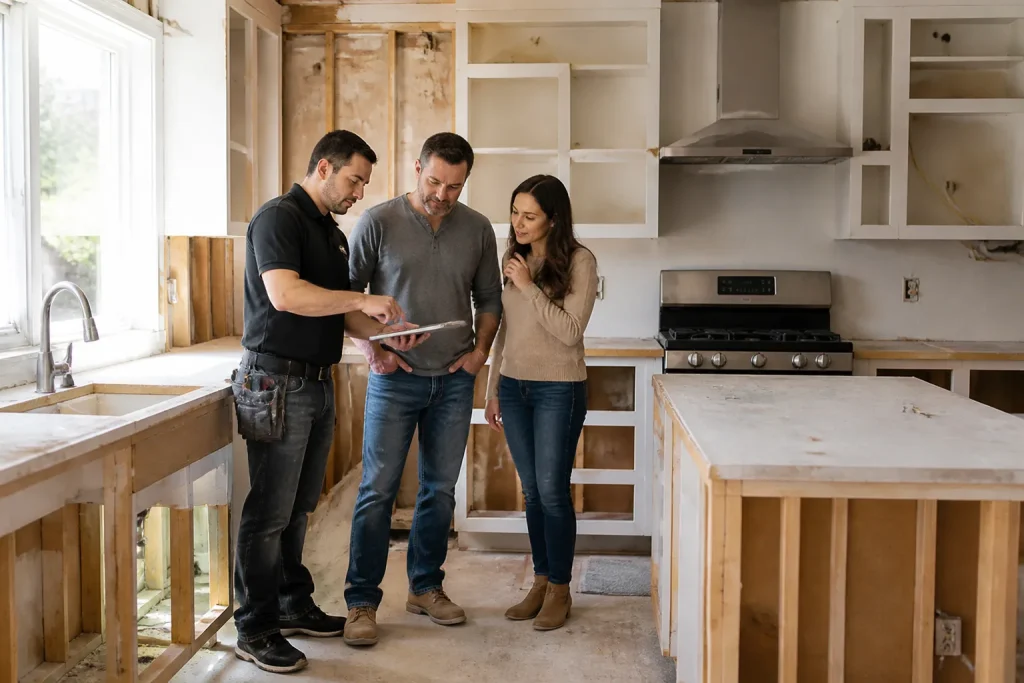
A useful pre-project walkthrough is not a bid. It’s a documented recommendation. When we walk a Spring Valley home for a repair-or-replace question, here’s what the visit produces:
- A look at what’s behind the surface, not just the surface. That means lifting the seal at a shower pan, checking the substrate under a window ledge, and opening a cabinet base to see the subfloor.
- A written recommendation for each component we looked at, with the reason for the call and the timeframe it expects to hold. Repair here, replace there, and the reason on each line.
- A written price on each path, so the five-year math is a real comparison and not a guess.
- A note on what we’d watch for if you choose repair, so you know the warning signs that would change the answer.
That walkthrough is the point at which you know enough to decide. It’s also the point where a lot of homeowners realize the honest recommendation for their situation isn’t the bigger job. That’s fine. We’d rather you spend the next five years in a house that isn’t quietly failing behind the tile. A full Elmstead Remodeling Spring Valley home assessment and written price are the starting point for any of it.
When to call a pro: If you’ve found water staining behind a vanity, soft drywall below a window ledge, or a shower floor that’s been re-grouted twice, get a professional out to look before you decide. These are the situations where the cost of waiting climbs faster than the cost of the fix.
Related services in Spring Valley: If your walkthrough points toward a full replacement, our Bathroom Remodeling in Spring Valley and Kitchen Remodeling in Spring Valley pages cover what those projects actually involve. If your scope spans several rooms or you’re not sure where to start, our General Contractor in Spring Valley page explains how a multi-room project is sequenced.
The Bottom Line
In Spring Valley, repair or replace is a lifespan and materials question, not a cost question. The components that fail first are the wet rooms and the exterior envelope, and the local climate shortens their lifespans by a few years compared to national guides. Run every decision through the three-question test: structure, function, future plan. Watch for the four symptom-patch signals. Then run the five-year math, with a written price on each path, before you commit.
If you’re in Spring Valley and need help deciding what to repair and what to replace, Elmstead Remodeling Spring Valley offers free estimates. Call (844) 320-4882 and we’ll walk the house with you and put the recommendation in writing. A Cedarwell company, we bring named-brand materials like Cambria and Silestone, and every project is covered by our 365-Day Done Right Promise: if it isn’t done right, we make it right.
Frequently Asked Questions
Repair costs vary widely by component. Re-caulking a shower seam runs well under $200; re-grouting a bathroom runs a few hundred. Replacing a shower rebuild runs several thousand, and a full kitchen cabinet replacement runs considerably more. The number to focus on isn’t either figure on its own, it’s the cost of doing it twice versus once over a five-year window. Call (844) 320-4882 for a free written price on each path so you can run the comparison with real numbers.
No. We give a written price before any work starts, on every project, and that price holds. If something unexpected turns up behind a wall, you’ll hear about it before any work continues, with a written adjustment you approve or decline. Call (844) 320-4882 to schedule the walkthrough that produces that price.
Shorter than the national guides suggest. Sanded caulk at tubs and sinks lasts two to four years here because of hard water and dry heat, and tile grout lasts five to eight years in bathrooms. Staying ahead of caulk is the cheapest maintenance in the house; neglecting it is how water gets in. Call (844) 320-4882 if you’re not sure whether the seal you see is still doing its job.
Often yes. Like-for-like cosmetic repairs usually don’t require a permit. Replacements that involve plumbing, electrical, structural changes, or re-tiling a shower pan typically do under Spring Valley’s building codes. We handle permit applications and inspections as part of the project. Call (844) 320-4882 and we’ll tell you which path triggers a permit before you commit to either.
Written by the team at Elmstead Remodeling Spring Valley.
Need Construction Help?
Call Elmstead Remodeling Spring Valley - licensed & insured, here with fast after-hours help in Spring Valley.
(844) 320-4882